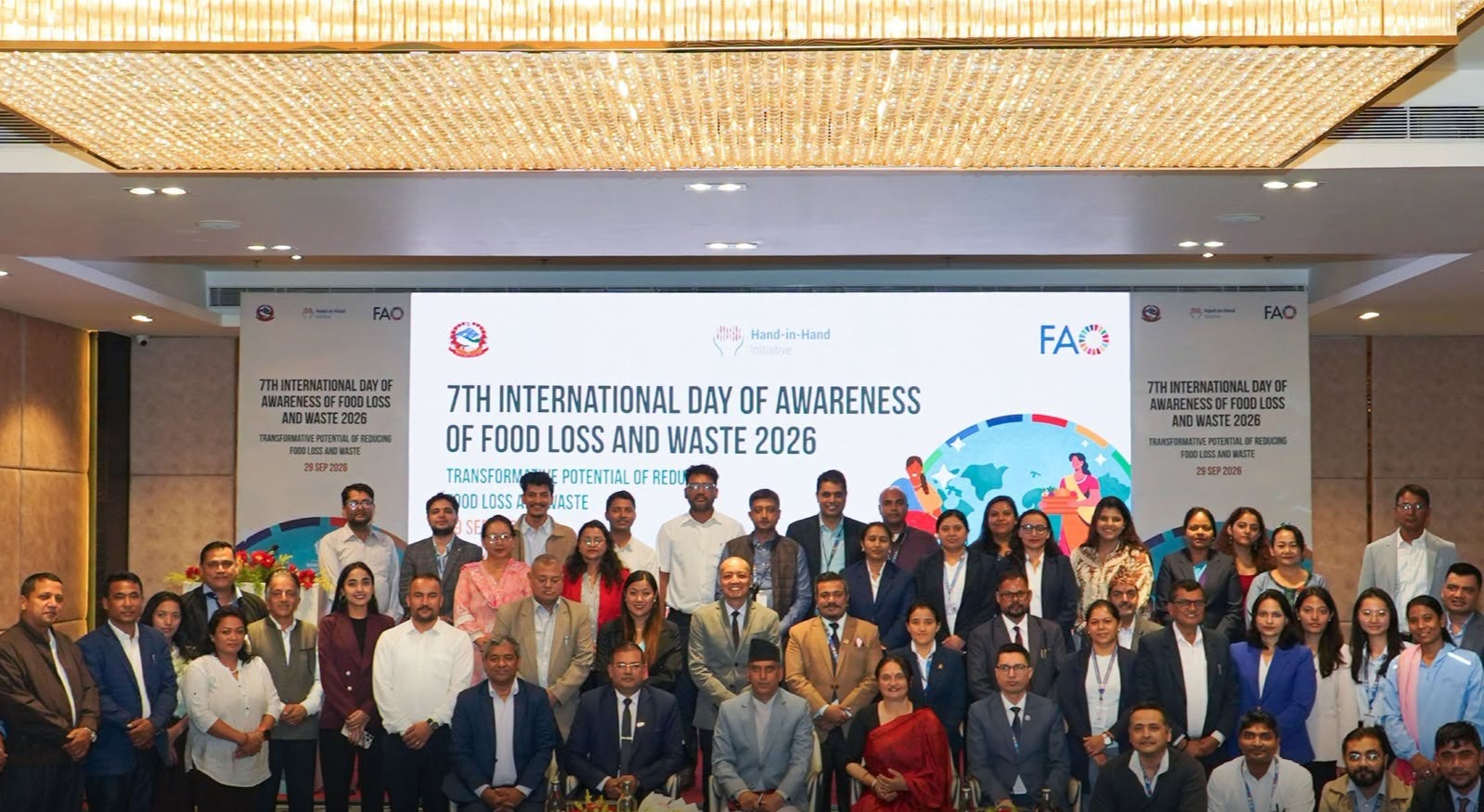
This piece is based on a recent interview with Mr. Sudeep Bajracharya, Director, Growth and Innovation at Mandala Foods, who delivered the keynote at the International Day of Awareness of Food Loss and Waste (IDAFLW) 2026 in Kathmandu on 29 September 2026. This year, the Center for Agriculture Communication and Human Resource Development (CACHRD), under the Ministry of Agriculture, Forests and Environment, observed IDAFLW with FAO Nepal for the first time.
Tell us briefly about IDAFLW and why was Mandala Foods invited?
The International Day of Awareness of Food Loss and Waste (IDAFLW) is a UN observance held every 29 September, co-convened by the Food and Agriculture Organization (FAO) and United Nations Environment Programme (UNEP) in support of SDG Target 12.3. The day highlights the urgent global problem of food waste and encourages solutions across the entire food supply chain.
Mandala Foods turns surplus and cosmetically rejected fruit into reduced-sugar, high-fibre foods for domestic and international markets, giving products that would otherwise be discarded a second life. Working at the point where food loss happens, we convert waste into nutritious, value-added products. Our sister company, Mandala Agrifresh, works alongside farmers on post-harvest management, so less produce is lost before it ever reaches us.
About 60 people from government, business, academia, and civil society attended. Mandala Foods was invited to give the opening keynote, and we take that as an invitation to say plainly what we see from inside Nepal's agri-food value chain.
What is the difference between food loss and food waste?
Food loss occurs earlier, from production up to the retail level. It covers produce that rots on the farm, is damaged during harvest, spoils in poor storage, or is lost in transport and processing. It is usually caused by gaps in infrastructure, technology, or handling, such as a lack of cold storage or rough roads.
Food waste occurs at the end of the chain: retail, food service, and households. It covers things like supermarkets discarding unsold or damaged items, restaurants throwing away leftovers, and people letting food spoil at home. It is usually caused by decisions and behaviour, such as over-buying, strict cosmetic standards, or confusion over date labels.
How much food does Nepal lose? Is there a national database that you know of to monitor the loss?
Around the world, roughly a third of all food produced is never eaten. It is lost along the supply chain or thrown away. According to Project Drawdown's 2025 analysis, which draws on FAO and World Resources Institute data, this wastes about a trillion US dollars every year. It also carries a heavy climate cost: around 4.9 gigatonnes of greenhouse gas emissions come from food that was grown but never eaten.
In Nepal, no single figure fits every food or supply chain. Khatiwada et al. (2022) found that 20 to 50 percent of fresh fruits and vegetables are lost before reaching consumers. The main causes are inadequate cold-chain infrastructure, poor roads, unscientific packaging, and long journeys to market. Products that fail cosmetic standards also have no clear buyer.
That is only part of the picture. Losses in shops and household kitchens are harder to see, because reliable food waste data in Nepal is still lacking. A 2023 survey by Mandala Agrifresh of fruit retailers in the Kathmandu Valley found that up to 20 percent of the fruit they handled went unsold. This shows why we need to look beyond the farm and the journey to market, and start measuring what happens at the end of the chain.
What is the government doing?
- The Center for Agricultural Communication and Human Resource Development and the Ministry of Agriculture, Forests and Environment, with FAO Nepal, organized the first IDAFLW event in Nepal and broadcast a related plenary on Nepal Television on 27 September.
- An FAO–government pilot measured loss directly: tomato ~16%, milk ~5%.
- Nepal has invested in cold storage.
- The school meal budget has risen from Rs 15 to Rs 20 per child, which is an opening to buy local, imperfect-but-good produce.
- Follow-up short-, medium-, and long-term plans are being developed with FAO Nepal.
You’ve worked on this issue from the development sector as well as the private sector end. What needs to be done to address this issue at a national/regional level?
Everyone can see the loss, but whoever pays to fix it gains little, and the cost is passed on to producers and consumers. There could be four connected steps:
- Produce to meet buyers’ volumes.
- Handle and pack better to add shelf life.
- Transform surplus and imperfect food into a form another market can use.
- Measure directly and often. Nepal has measured only two commodities, once, and has no regular national system.
Cold storage on its own can increase loss without a post-harvest and market system around it, and edible food should feed people first, fresh or processed, before animals, compost or energy.
Government should set a target and put procurement behind it; donors should fund missing links long term; producer groups should aggregate and build handling capacity; researchers should measure directly; and the private sector should become the buyer for produce that fails fresh-market standards. In addition, Government agencies, universities, INGOs and private organisations should all invest in further research on food loss and waste in Nepal, whether on their own or in partnership.
What were your key takeaways from this year’s IFAFLW? What can actors do to address food loss and waste?
- Nepal does not lack good food. It lacks the connections that move that food to people who can use it. The imperfect apple is still good to eat. The question is whether Nepal builds what it takes to make it usable.
- Food loss is also nutrition loss. The event promoted this message and encouraged efforts to keep food fresh and to make better use of surplus food.
- National action is needed. The organisers emphasised that integrated national initiatives, investment in technology across the food value chain, and changes in consumption and handling practices are important for strengthening climate resilience and food security.
- Measure before planning. The main argument was that strategies and implementation plans should not be built on perceptions of food loss and waste. Nepal needs direct, regularly repeated measurements to know where food is lost and to act where it matters most. The government is also planning to include the concept of food loss in every national food-related event and debate, mainly to instill awareness among people who are unaware of the cause and consequences of food loss.
Sources: IDAFLW 2026 concept note (CACHRD/FAO Nepal); Mandala Foods keynote, 29 Sept 2026; DevPulse, “FAO Nepal Calls for National Action to Reduce Food Loss and Waste” (30 Sept 2026).