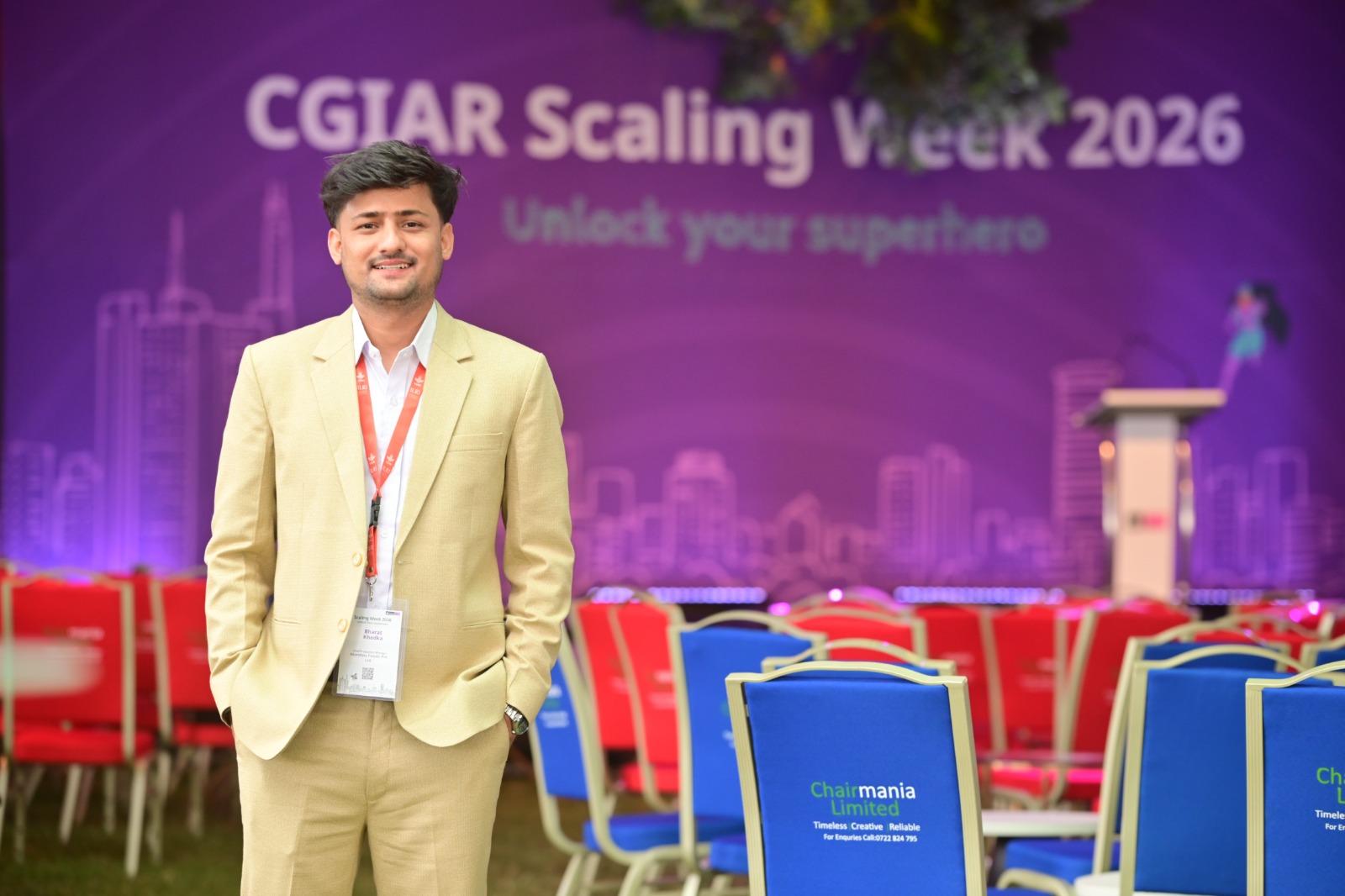
Bharat Khadka, from Mandala Foods' production team, came back from CGIAR Scaling Week 2026 in Nairobi with an important lesson: scaling should shape an idea from day one, not arrive after it works. He travelled on 21 September 2026 as a Future Impact Scalers Award recipient representing Mandala Foods, Nepal. This post shares what we learnt together as a company and how it applies to food loss and waste in Nepal.
What did the first morning in Nairobi teach?
Bharat walked into a hall of strangers at the International Livestock Research Institute. The organizers sent everyone to a Red Room and a Yellow Room, where each person had to meet someone new, take a photo together, and upload it to the Whova app. No one could stand alone because everyone had the same task. His takeaway: start. Good ideas, like good conversations, need the right people and conditions around them.
What did Mandala Foods learn about scaling?
1. Start with the market. A product can work technically and still struggle to find buyers. The question is not only "What can we make from this product?" but "Who needs it, and will they keep paying for it?"
2. Relationships are an asset. Several participants already knew Mandala Foods, one through our CEO at a World Bank programme in Sri Lanka. That network only helps if we follow up after events.
3. Experience is an asset. Every trial, quality issue, and customer conversation teaches something. Written down, it becomes knowledge the whole team can use.
4. Ask early who pays for scale. Demand, unit economics, supply reliability, and investment matter as much as technical feasibility. Stopping an idea when the evidence does not support it is good decision-making, not failure.
5. Look beyond existing markets. When Bharat mentioned Mandala Food’s apple purée, participants said it is needed in Kenya. It was only a conversation, but it showed that Nepali products may meet needs elsewhere.
What does this mean for food loss and waste in Nepal?
Reducing food loss in Nepal needs a reliable buyer for surplus products, not only a way to process it. Fruit and vegetables can lose value after harvest, when supply exceeds what the local market can absorb, or when quality does not meet market specifications. Processing is one answer, but Scaling Week showed that it only lasts when demand is proven, and the solution can continue after project support ends.
What new practices can Mandala Foods bring to Nepal?
These are directions Mandala Foods intends to explore, not completed programmes. Each practice feeds the next: a market conversation can lead to a partnership, a partnership can bring knowledge, and better knowledge reduces food loss and waste.

What question is Mandala Foods carrying forward?
The question Bharat brought home is not only "What can Mandala Foods scale?" but "How can Mandala Foods help to create a large-scale impact on food loss and waste, and what will it take to get there?"
If you are a buyer, researcher, investor, farmer group, or development partner working on food loss and waste in Nepal, get in touch through mandalafoods.co.
Thank you to the CGIAR Scaling Week organizers and the Future Impact Scalers Award team for the opportunity to represent Nepal.
Prefer to hear it directly? Watch Bharat explain what scaling means to him below.